
Skip to content

Pediatric Eye Exams in Cincinnati, OH

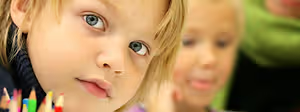
A child with blue eyes is looking at the camera while holding a bunch of colored pencils, with another child looking at something in the blurry background

Regular eye exams help protect your child’s vision and development. Pediatric eye care incorporates special techniques and technology to ensure accurate testing and help us accommodate young children.

Eighty percent of learning is visual, so difficulty seeing clearly can affect your child’s ability to learn. This is especially true for infants who develop and learn about the world around them through their sense of sight. Eye doctors should check your child’s vision at key stages to support normal development.

According to the American Optometric Association (AOA), children should have eye exams at 6 months, 3 years, at the start of school, and every year after. Children with vision concerns or risk factors, such as developmental delays, premature birth, or a family history of eye issues, may need more frequent exams. A child who wears eyeglasses or contact lenses should have annual eye exams. Children’s eyes can change rapidly as they grow.

Eye Exams in Infants: Birth-24 Months

A baby’s visual system develops gradually over the first few months of life. They have to learn to focus and move their eyes, and use them together as a team. The brain also needs to learn how to process the visual information from the eyes to understand and interact with the world. Vision development supports motor skills like crawling, walking, and hand-eye coordination.

Monitor your baby’s development and schedule a comprehensive eye exam at 6 months to track milestones. During this exam, the doctor checks vision development and screens for conditions like strabismus, farsightedness, nearsightedness, and astigmatism.

Infants born prematurely or showing developmental delays may need more frequent visits to monitor progress.

Eye Check-Up in Preschool Children: 2-5

The toddler and preschool age is a period when children experience drastic growth in intellectual and motor skills. During this time, they will develop the fine motor skills, hand-eye coordination, and perceptual abilities that will prepare them to read and write, play sports, and participate in creative activities such as drawing, sculpting, or building. This is all dependent upon good vision and visual processes.

At this age, parents should watch for signs of lazy eye (amblyopia), when one eye does not see clearly, or crossed eyes (strabismus), when one or both eyes turn inward or outward. The earlier these conditions are treated, the higher the success rate.

Parents should also watch for delays in object, number, or letter recognition, color recognition, or coordination, as these issues may be vision-related. If your child squints, rubs their eyes, sits very close to the TV or reading material, or avoids activities like puzzles or coloring, schedule an eye exam.

Eye Exams in School-Aged Kids: Ages 6-18

Undetected or uncorrected vision problems can cause children and teens to suffer academically, socially, athletically and personally. If your child is having trouble in school or after-school activities, there could be an underlying vision problem. Proper learning, motor development, reading, and many other skills are dependent upon not only good vision, but also the ability of your eyes to work together. Children who have problems with focusing, reading, teaming their eyes or hand-eye coordination will often experience frustration, and may exhibit behavioural problems as well. They often don’t realize their vision is abnormal, so they can’t express that they need help.

In addition to the symptoms written above, signs of vision problems in older children include:

  • Short attention span
  • Headaches
  • Frequent blinking
  • Avoiding reading
  • Tilting the head to one side
  • Losing their place while reading
  • Double vision
  • Poor reading comprehension

What We Evaluate During Your Child’s Eye Exam

In addition to basic visual acuity (distance and near vision, or refractive errors), an eye exam may assess the following skills:

  • Binocular vision: how the eyes work together as a team
  • Focusing
  • Peripheral vision
  • Color vision
  • Hand-eye coordination
  • Tracking

The doctor will also examine the area around the eye and inside the eye to check for any eye diseases or health conditions. Share your child’s medical history, including premature birth, developmental delays, eye injuries, medications, or family history of eye conditions. Use this time to address any concerns that may indicate a vision problem.

Children's Eyeglasses, Contacts, and Other Treatments

If your child has a vision problem, the doctor may recommend treatments such as eyeglasses, contact lenses, an eye patch, vision therapy, or ortho-k, depending on the condition. Early diagnosis is important because many conditions are easier to treat while the eyes are still developing.

Following exam guidelines and watching for vision issues can help your child reach their full potential.